Cava vs. Corpinnat: An Expert's Guide to Catalan Sparkling Wine
© Corpinnat
If you’ve ever been to our wine shop wondering whether a Cava or a Corpinnat is “a better choice”, our most common answer is: it depends.
Despite sharing the same elaboration method, origin and tradition, Cava and Corpinnat have some key differences that need to be considered, and those differences do show up in the glass.
But first, let’s take a look at where these 2 styles of Catalan sparkling wine come from and what they have in common:
Cava and Corpinnat: the quality of traditional method
Cava and Corpinnat are both made with the traditional method of production – the same way Champagne and Crémant are made.
Unlike the Charmat method, where the elaboration process results in simple, less complex bubbles (like Prosecco) , a traditional method or “méthode champenoise” is based on a second fermentation of the base wine inside the bottle to achieve texture and complexity.
But what sets Cava and Corpinnat apart from Crémant or Champagne is the primary use of indigenous grape varieties to achieve its fine bubbles and complex aromas, such as traditional Xarel·lo, Macabeu or Parellada, grown in the historical wine region of Penedès near Barcelona.
That is an important nuance when considering quality sparkling wines beyond Champagne, as they don’t rely on classic Pinot Noir and Chardonnay grapes to produce sparkling wines with a distinct character and personality.

© Corpinnat
Shared heritage: Penedès terroir
Both Cava and Corpinnat trace their roots to Penedès, Catalonia’s sparkling wine heart. The first bottle-fermented sparkling wines were produced in the regional town of Sant Sadurní d’Anoia, dating back as early as 1887.
Penedès offers an ideal terroir – limestone soils, warm sunshine and cool nights – for the growing of high-acid, ageworthy grapes that impart a distinct minerality and salinity to the wines. In fact, Corpinnat’s principles explicitly emphasize the “optimum conditions” of the Penedès for the production of wines with a unique identity.
Production rules: a different approach
A minimum aging period in the bottle as well as a wider production scope define the key differences between the 2 styles of sparkling wine:
Cava’s broader rules:
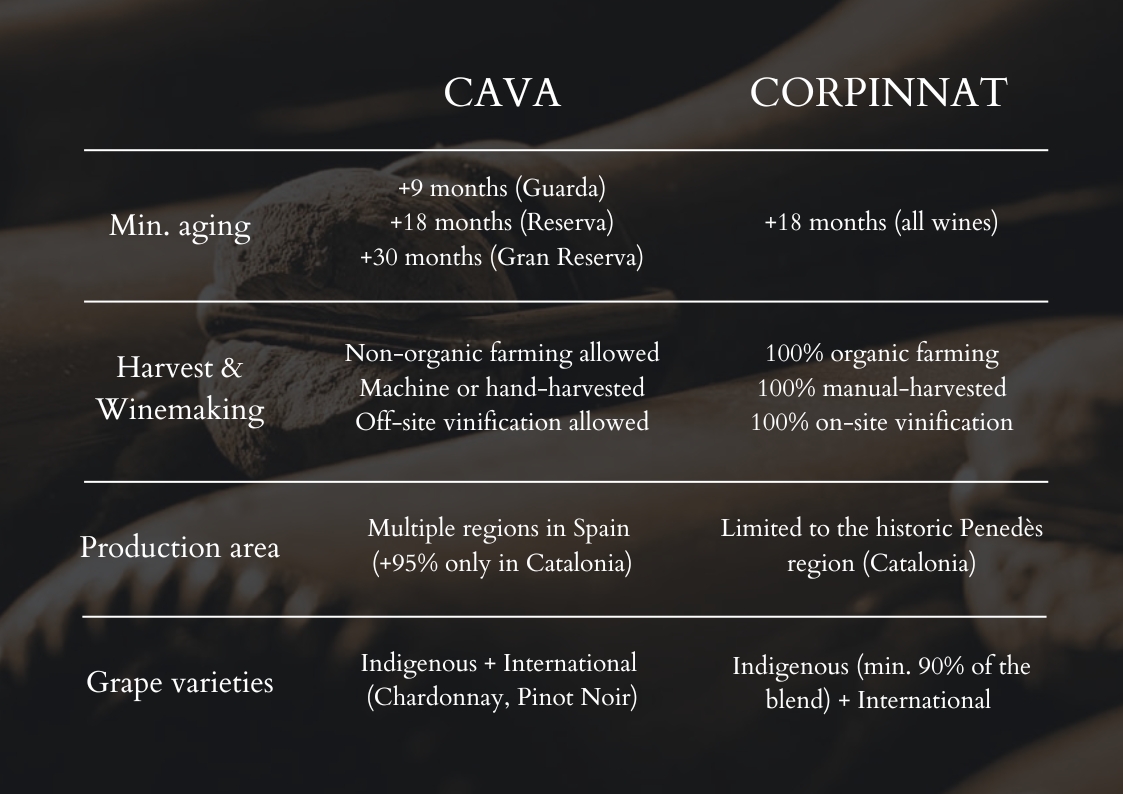
With a minimum aging period of 9 months, the Cava DO has many permitted regions for its production beyond Catalonia’s Penedès, and a wider production scope.
Within this framework, producers must follow defined technical requirements: the traditional method (second fermentation in the bottle), approved grape varieties, and longer aging periods for higher categories (ranging from a minimum of 18 months for Reserva and 30 months for Gran Reserva styles).
Corpinnat’s tighter grip:
By contrast, Corpinnat is a collective trademark (EU-level) that imposes much stricter rules, such as:
All vineyards must be 100% organic within the 46-municipality zone that spans across the Penedès.
Commitment to the historical Penedès varieties (only native varieties are allowed to be used for the 90% of the blends).
Harvest is entirely manual, and all vinification happens in the premises of the winery.
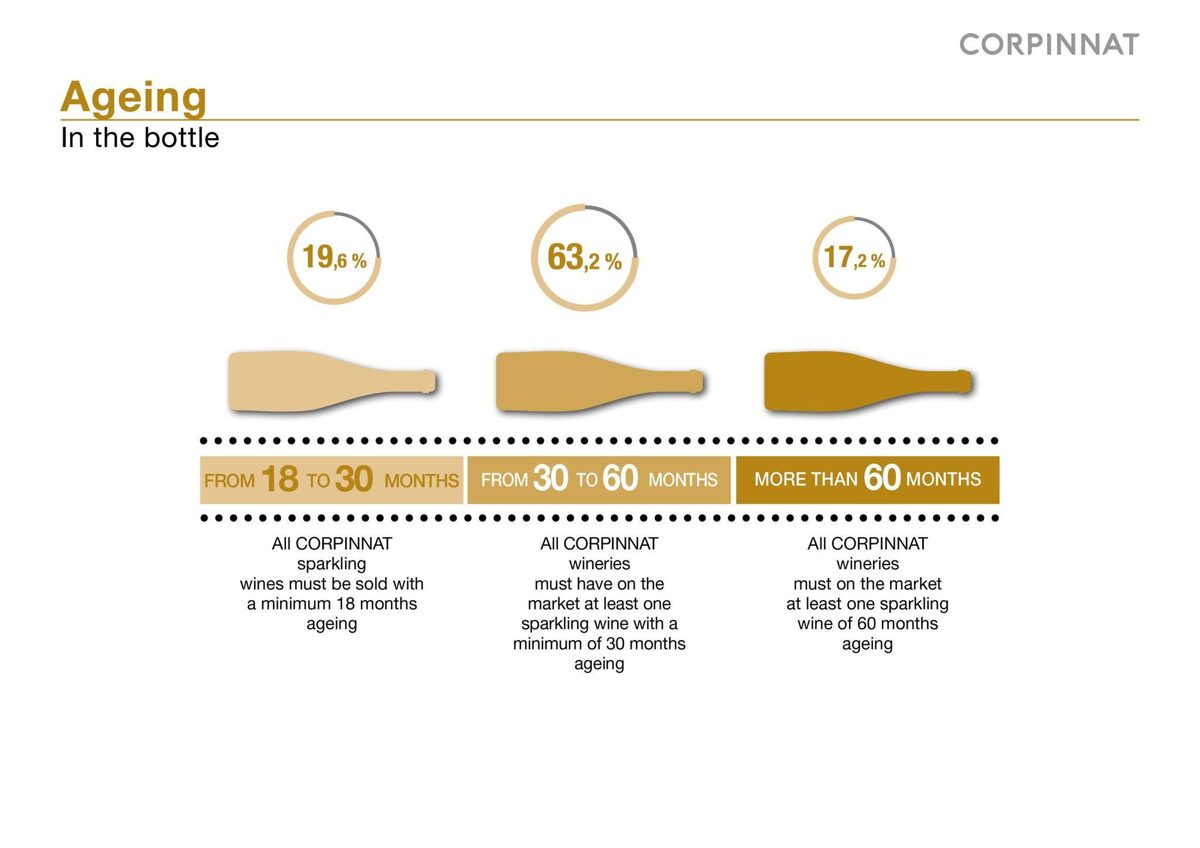
Yields are kept low to favour long aging quality sparklings (a minimum aging of 18 months is mandatory for all wines, plus every member must have at least one sparkling aged for 30 months and another for 60 months.)
Territory: Penedès vs. “Anywhere Cava”
While Penedès is the historic heartland of Cava (Sant Sadurní d’Anoia is often called the “capital of Cava”), the official Cava Designation of Origin includes many other areas in Spain.
The Cava zones:
The D.O CAVA regulatory board demarcated multiple Cava zones that span mainly in Catalonia (with 5 distinct sub-zones to show differences of origin and terroir) where at least 95% of the production is concentrated, as well as other small areas in Valencia, Extremadura, and La Rioja.
This broad footprint helped Cava become the Spanish sparkling wine everyone knows today, but that means sparkling wines labeled as “Cava” might come from very different terroirs and, most importantly, quality levels.
Production increase and market expansion:
During the 1980s and 90s, Cava consumption and demand heavily increased, both in domestic and international markets. That is why major Cava houses such as Freixenet and Codorníu decided to increase their production beyond Penedès to meet global demand.
This growth established Cava as one of the world’s most recognized traditional-method sparkling wines, although it also contributed to its perception of a primarily mass-market product, and therefore, lowered its reputation as a quality sparkling wine that once was perceived as.
As of today, under the D.O. Cava’s structured quality controls, updated zoning and aging classifications, Cava represents a wide spectrum of styles and quality levels.
Commitment to Origin:
Going the opposite way, Corpinnat rejected that sprawl, limiting the 100% of its production to the historic area of Penedès.
The defined Corpinnat territory is one contiguous block of around 997 km² within the Penedès region. In other words, while any qualified vineyard in Spain could (theoretically) make Cava, Corpinnat says: only Penedès. This commitment to origin is a badge of pride: Corpinnat’s very name links "Cor” (heart in Catalan language) and “Pinnat” (from Pinnae, Latin for Penedès).

© D.O. Cava
Style and market position
Because of its broader rules, Cava’s range covers a wider spectrum of styles. There are basic Cavas meant for immediate drinking, Extra Bruts with crunchy green fruit, rosé Cavas, and lengthier Reservas and Gran Reservas for more structure.
Cava’s flexibility also means you’ll see more budget bubbles and some mass-market brands, which can give newcomers the wrong impression.
Corpinnat’s niche: Corpinnat, on the other hand, has chosen to embrace the premium end of the spectrum, where all their sparklings are effectively:
“Reserva” or “Gran Reserva” by aging period and style.
Mostly Brut Nature (zero dosage) or Brut, with lengthy ageing potential that gives them layered, autolytic complexity.
Produced by traditional winemakers with historical ties to the Penedès region.
The net result: Corpinnat sparklings tend to be seen as more high-end and terroir-focused. They often have smaller production and higher prices than entry-level Cavas, reflecting the cost of 100% estate organic farming and long aging periods.
Cava vs Corpinnat: a quick summary
© Raim Catalan Wines
Which sparkling wine is best for you?
Cava and Corpinnat are quality sparkling wines made using the traditional method along indigenous grape varieties, mostly from the Penedès region.
Here’s a quick guide to help you choose which Catalan sparkling wine is best for you:
If you like it light and fresh:
Cava probably offers a wider variety in terms of body and complexity, from standard Reserva where bubbles are still quite fresh and vivid to longer-aged Gran Reserva, with a more integrated bubble and longer finish.
Our recommendations:
If you like it fruity and aromatic:
Both Cava and Corpinnat may produce wines with intense fruity aromas and flavours. That is the case of sparkling wines elaborated with highly aromatic grapes, such as Pinot Noir or Garnatxa Negra, both contributing to adding flavour and complexity to the resulting wines.
Our recommendations:
If you like it lean and mineral:
Once again, both Cava & Corpinnat styles produce mineral, terroir-driven sparklings along the lines of the best Blanc de Blancs Champagnes. However, where Cava may fall short on some occasions, Corpinnat can deliver the elegance and finesse this style is internationally recognized for.
Our recommendations:
If you like it rich and complex:
Thanks to the long-aging periods on the lees, Corpinnat excels in the production of wines that boast rich and complex nuances; from classic secondary aromas of pastry and brioche to deliberately oxidised ones.
Our recommendations:
© Raim Catalan Wines
Our mission: ambassadors of Penedès
At Raim Catalan Wines we are committed to highlight both sides of the sparkling winemaking tradition from Catalonia. That’s why we exclusively represent Cava and Corpinnat sparkling wines elaborated in the Penedès region to showcase the best quality of origin and terroir.
Established Corpinnat members and boutique Cava producers who share the spirit of their ancestors. Each bottle - whether labeled “Cava” or “Corpinnat” tells a bit of Penedès as one of the finest winemaking regions of the world.
Learn more about our premium sparkling wines from Penedès here.
Article by Oriol Bernad,
Raim Catalan Wines co-founder & tasting director.